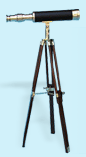










Surveyor Compass
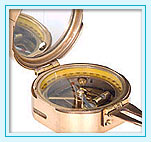 The
surveyor's compass is an instrument for determining the horizontal direction
of a line with reference to the direction of a magnetic needle. The compass
is set over a point on the line of the bearing which is desired and the
compass is leveled. The peep sights are directed to some point along the
line, and the needle is lowered on to the pivot. The bearing is determined
by observing the angular value on the graduated scale opposite the end of
the needle, and the quadrant is determined by observing between which
letters on the compass-box the end of the needle lies.
The
surveyor's compass is an instrument for determining the horizontal direction
of a line with reference to the direction of a magnetic needle. The compass
is set over a point on the line of the bearing which is desired and the
compass is leveled. The peep sights are directed to some point along the
line, and the needle is lowered on to the pivot. The bearing is determined
by observing the angular value on the graduated scale opposite the end of
the needle, and the quadrant is determined by observing between which
letters on the compass-box the end of the needle lies. Although there are many varieties of surveyor compasses, they all fall into two main categories: either a "plain" compass or a "vernier" compass. A plain compass has no adjustment and always reads magnetic north. A vernier compass has an adjustable scale that allows for the "setting off" of the magnetic declination and the compass can then directly read true north.